Open every day
Mon. Tue. Thu. Fri.: 10:00 AM - 5:30 PM
Wed. Sat. Sun.: 10:00 AM - 6:00 PM

Forests

Bolivia, Brazil, Peru.

23–29 cm

450–550 g

15 years

5 months

Fruit-eating and insect-eating

Conservation and Breeding Program at Wildlife Parks

La liste rouge mondiale de l’UICN des espèces menacées
Depuis les années 1960, l’Union Internationale pour la Conservation de la Nature publie la Liste rouge des espèces menacées. Les espèces sont classées dans des catégories indiquant le degré de menace auquel elles sont confrontées.
List the species that have not yet been assessed against the Red List criteria.
Includes species for which the best available data are insufficient to determine, either directly or indirectly, their risk of extinction.
List the species that are at low risk of extinction in the region in question.
Includes species that are close to meeting the quantitative thresholds for threatened species and that could become threatened if specific conservation measures are not taken.
Includes species threatened with extinction. Relatively high risk.
Includes species threatened with extinction. High risk.
Includes species threatened with extinction. Very high risk.
Refers to species that survive only in captivity or as part of a naturalized population.
A species of which there is no doubt that the last individual has died.
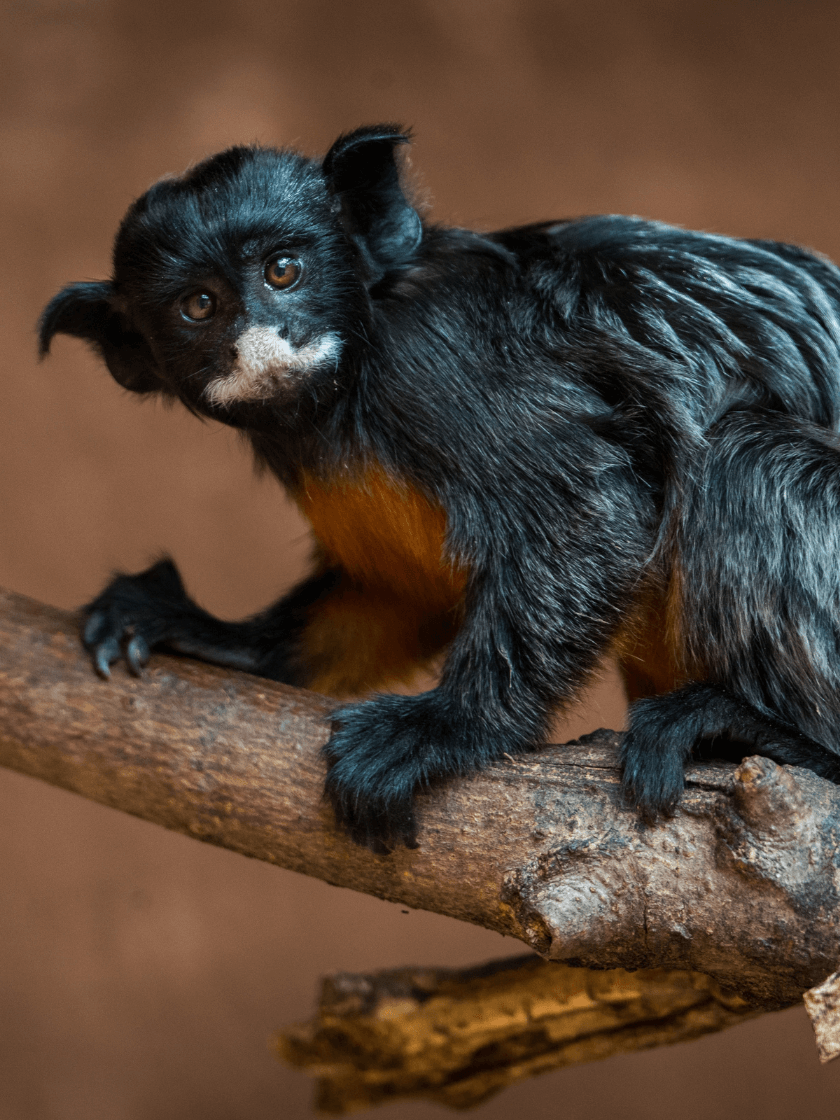
Tamarins and marmosets are small South American primates, grouped under the term Callithrichidae. The smallest among them is also the smallest monkey in the world: the pygmy marmoset weighs about 120 g. The largest is the lion tamarin, weighing up to 750 g.
Callithricidae live in social groups, generally consisting of several adult males and females, juveniles of various ages, and a single breeding female. All members of the group participate in caring for and carrying the infants. Sometimes, the mother cares for the infants only to nurse them.
Communication is visual, auditory, and olfactory. Visual communication includes a range of facial expressions and postures. The vocal repertoire is extensive, and different calls serve various functions, including defense and group cohesion. Females use scent marking more often than males, particularly to signal their readiness to breed. Males use it to mark territory and establish hierarchy within the group.
The white-cheeked tamarin forms alliances with other Callithricidae species to enhance surveillance of a shared territory and defend it.